
“You don’t need to know everything to take the first step.”
Laura Koenders
24-11-2026
By Laura Koenders
In my work at PYM, I regularly come across incredible projects and funds that are developing solutions to social and environmental challenges. And I often find myself thinking: yes, I would love to invest in this! But with a minimum investment of €100,000 (and that is often still on the lower end), it is just beyond my budget.
Starting small with impact investing: learning by doing
In my work at PYM, I regularly come across incredible projects and funds that are developing solutions to social and environmental challenges. And I often find myself thinking: yes, I would love to invest in this! But with a minimum investment of €100,000 (and that is often still on the lower end), it is just beyond my budget.
Of course, you don’t have to start with amounts like these. In fact, particularly if you intend to invest larger amounts in the future, it can be valuable to gain experience on a smaller scale first. How does an investment actually work? What risks are you comfortable taking? And how do you assess whether your money is genuinely making a positive impact?
So I decided to do some research of my own. How could I invest smaller amounts in the two Ps, People & Planet, and perhaps generate some Profit along the way?
I have since discovered several ways to start impact investing with relatively small amounts. And although I am still very much learning myself, I would love to share my experiences.
This article is based on my personal experiences and does not constitute financial advice. The organisations mentioned serve as examples, not investment recommendations. Always do your own research into the current terms, costs and risks before investing.
Start with a plan
During my research, I kept coming across the same warning: investing involves risks. You could lose some or all of your investment, and some investments tie up your money for longer periods of time.
That is why I started by setting a budget. How much money can and do I want to invest without needing it in the short term? And how much of a loss could I absorb?
I have chosen to dedicate an average of 10% of my income to positive impact, divided between investments and donations. Perhaps 10% feels like a good starting point for you too, or maybe 3% is more appropriate. Or you might prefer to look at how much you have left each month after paying your fixed expenses. There is no single percentage that works for everyone. The most important thing is to choose an amount that suits your personal circumstances and that you feel comfortable with.
With that budget in mind, I started exploring different opportunities.
1. Investing in sustainable funds
As I had little investment experience, I started with my own bank, ASN. There, I could invest in various sustainable investment funds with as little as €20.
I set up an automatic monthly transfer of a fixed amount to my investment account. I then allocate that money across different funds, focusing on areas such as sustainable businesses, biodiversity and microfinance.
When selecting funds, I considered their risk levels, expected returns, past performance and, of course, whether the theme appealed to me. By investing in different funds, I aim to diversify my risk. Investing smaller amounts regularly also means that I am not dependent on a single entry point.
Several banks, including ASN, Triodos and ABN AMRO, now offer sustainable investment funds that allow you to start with small amounts.
However, it is important to understand what a fund actually invests in. A fund that buys shares in publicly listed companies, for example, works differently from one that provides loans directly to sustainable businesses. Not only do the risks and the ability to withdraw your money differ, but so does the way your investment can make an impact. Furthermore, the label ‘sustainable’ does not automatically mean that a fund actively contributes to solving social or environmental challenges.
For me, investment funds are primarily an accessible way to gain experience and build wealth over the long term.
2. Financing entrepreneurs through microcredit
Alongside investment funds, I wanted to try something that would allow me to see more clearly what was happening with my money.
My colleague Veerle Berbers, co-founder of PYM and an experienced impact investor, told me that one of her first investments was in microcredit. That sparked my curiosity.
After some searching online, I came across Lendahand, a Dutch crowdfunding platform that allows you to finance entrepreneurs and projects in emerging economies.
Many of these entrepreneurs struggle to obtain loans through traditional banks. Crowdfunding allows multiple investors to collectively provide the capital they need.
What I like about Lendahand is that you often get a tangible sense of the business you are financing and what your money is making possible. This might be the purchase of new machinery or the expansion of a business. You can also choose which projects appeal to you. Personally, I like to select projects led by women or businesses that make and sell their own handcrafted products.
Unlike a donation, the intention is that you get your money back, potentially with interest. Of course, this is not guaranteed. Entrepreneurs may experience financial difficulties, and you could lose your investment.
I particularly like the idea of reinvesting repayments and returns into new projects. If all goes well, the same money can be used multiple times to help different entrepreneurs move forward.
There are other organisations through which you can contribute to microcredit with small amounts, such as Wakibi.
3. Investing directly in businesses through crowdfunding
I previously worked at a start-up that relied on angel investors. It is wonderful to see what individual investors can contribute to the growth of a business. However, the amounts involved are generally well beyond my budget.
Fortunately, there are also opportunities to invest directly in businesses with smaller amounts, for example through crowdfunding. By pooling capital with other investors, you can participate with a relatively small investment. Depending on the type of crowdfunding, you can either buy shares in a business or lend it money.
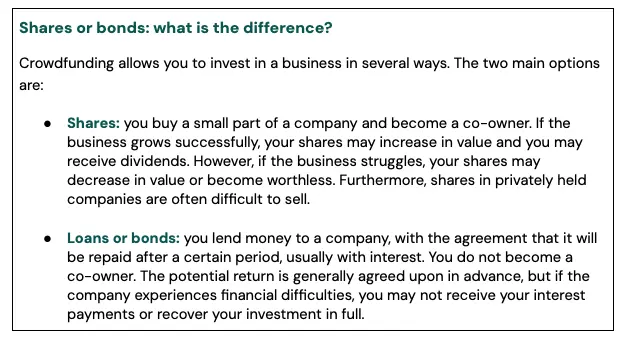
The first time I came across this type of investing was through MyWheels, the car-sharing company where I previously worked. Through The Sharing Group, they offer users the opportunity to invest. Although I knew the organisation well, at the time I still found it a little too daunting.
Not much later, I received a similar invitation from MOYU, a producer of rewritable notebooks made from stone paper. I was already a big fan of their products and decided to look into their investment round through Eyevestor. Coincidentally, a friend of mine had previously invested in European Sleeper, the international night train service, through the same platform. Being able to ask him about his experiences gave me the final nudge I needed to buy a share in MOYU myself.
What appeals to me about this way of investing is that you can directly contribute to the growth of a business whose mission and products you believe in. However, this also comes with greater risk. Young companies can go bankrupt, and shares in privately held businesses are often difficult to sell. It can also take years before you potentially receive a return.
For me, this is therefore a way to use a limited portion of my budget to invest in businesses that I am genuinely excited about. Since then, I have also invested in a bond through The Sharing Group and, through Invesdor, in a range of businesses, from sustainable agriculture and bamboo production in Europe to innovative medical technology and decentralised water supply.
Other similar crowdfunding platforms include Broccoli, Enerfip, Meewind and CrowdAboutNow.
Starting small is still starting
When I first joined PYM, I thought impact investing was primarily for people with substantial wealth. And although many impact funds do indeed have high minimum investment requirements, I have since discovered that there are also opportunities to get started with smaller amounts.
That does not mean that every sustainable investment automatically makes a positive impact. Whether your money genuinely contributes to change depends, among other things, on where it goes and what your investment makes possible.
You don’t have to invest €100,000 straight away to gain experience. Perhaps what I enjoy most about starting small is how much I learn from it. Not only about different types of investments, but also about my own preferences. Which businesses appeal to me? How much risk am I willing to take? And how do I determine whether an investment genuinely contributes to positive change?
By starting small, I can gain hands-on experience. And I will take that experience with me if I am in a position to make larger investment decisions in the future.
And perhaps that is the most important lesson I have learned so far: you don’t need to know everything to take the first step.