
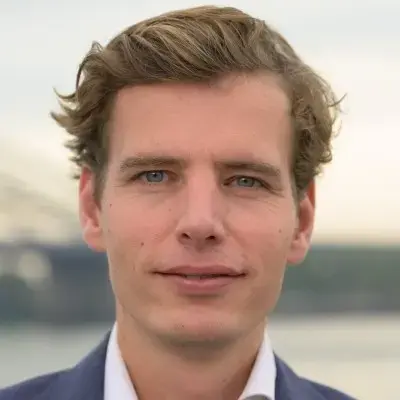
"The closer to the fire, the more fun."
Floris de Kort
25-11-2026
Floris de Kort worked in corporate finance until his father-in-law, Dick Slingerland, founder of Alphatron, died suddenly in 2020. That was when he and his wife Anna Sophie took over the family business. Their family office increasingly invests directly in companies, with a focus on climate, food and agri, and Africa. Anna Sophie also leads the family foundation.
How did you get into impact investing?
My father-in-law passed away so suddenly that the succession of his life's work was still completely open. With my experience at PwC and Rabobank, it made sense for me to take on a role. But going into impact investing in the first place was Anna Sophie's idea. She already had her own sustainable fashion company, Sophie Stone, and her father had always said that it was up to our generation to save the planet. With Wire Group, we wrote a policy for investing our wealth consciously, ranking the Sustainable Development Goals in order of what matters most to us.
As a son-in-law, you're in an unusual position. How do you and Anna Sophie divide the roles?
I handle the companies and investments. Anna Sophie focuses on the foundation. Together we do the impact investments. Anna Sophie took the "Impact Investing for the Next Generation" programme at the Center for Sustainable Finance and Private Wealth (CSP), a collaboration between the University of Zurich and MIT. It gave her a huge amount of knowledge and a large international network. We're colleagues, but we're also husband and wife, and father and mother. You trust and know each other more when you share your life, so it's very easy to coordinate. My father-in-law always used to say one shouldn't work with family, but every family is different. Our family dynamic is actually very straightforward. Of course the more family members one has, the more complex it gets, including, and maybe especially, for an in-law. So everyone benefits from clarity. We're very clear about who does what, and above all who doesn't do what. At the same time, it stays an open conversation.
How has your approach changed in recent years?
We make a lot of mistakes, and then we make different mistakes. That's part of it. We started with funds of funds, for example, and we don't do that anymore. We do still invest in funds, with tickets between 1 and 2.5 million euros, such as the Dutch fund Rubio or Nigeria's Ventures Platform. But I want to be closer to the fire. With a fund of funds, you're two layers removed from the companies. Direct investments carry the most risk, but they're also the most meaningful for us, so that's increasingly where we're heading. This year we sold a majority stake in Alphatron Medical, and those proceeds are going to impact as well. We're also working on sustainability in our own companies and our real estate. We held sessions at our companies with We Are Impact Collective, and for our buildings we're working with Vilisto, which makes smart thermostats, among others. And since this year, we've had an investment committee with an external member from FMO, who has a full vote. Some people have questioned this decision, because it does mean you no longer have full control. But we want to make the best decisions, and we believe a critical, independent voice will help us achieve that.
Which investment are you particularly proud of at the moment?
DOPS, a company that makes new products from residual materials. Regional development agencies could only take part if private capital got involved as well. In this case, we brought that capital, which allowed the whole round to close. Now the company has the wind in its sails. So it's not just an inspiring company we invested in; our investment also made a real difference.
What's an important lesson you've learned in impact investing?
Look closely at the cap table. Everything takes longer and costs more than expected. If there's no room to absorb a setback, management is effectively forced to focus on fundraising instead of running the business. Then you miss your milestones, and raising money gets even harder. It's a vicious circle that's hard to get out of. I didn't pay enough attention to this before. Now we look very deliberately at who is bringing what to the table, and also at how much flexibility they might have down the line.
How is the traditional finance world different from the impact world?
From the outside, the world of wealth seems very closed, but if you're open about where you come from and what you want, you actually get an open conversation in return. That was not the case for me when I was a corporate finance adviser. I always had to chase people and there was a lot of competition. Family offices are the opposite; a lot is shared. In Africa, for example, other Dutch families are already much further along, and we're able to draw on their networks. Everyone has the same goal and there's more than enough deal flow. It's an enjoyable world, where people's hearts are in the right place.
What or who inspires you?
VP Capital, the family office of the Van Puijenbroek family, is quite a bit further along in impact investing than we are. They're a real example and inspiration for us. And we recently took a small office at Norrsken House in Amsterdam, a co-working space for impact investors, funds and start-ups. You run into others over lunch, and that leads to new conversations, deals and insights.
What does PYM mean to you?
We found our way to PYM through Veerle and the Impact Days, and it was extremely useful for getting started and learning. It's especially great for investors who are just dipping their toes into this new world. Now that we're further along, we share our story and are committed to contributing to the network's mission.
How do you involve your children?
Our children are still quite young (7 and 9), so it's a bit early. But through Anna Sophie's programme, we found a coach who guides families through this. We're working with her on how and when to involve the children. So far, we mainly tell them about the foundation: what we do and where the money goes. They really enjoy hearing about it!
What would you do differently if you started over, knowing what you know now?
I'd immediately look for the right partners. Good co-investors often make all the difference. I'd also build in more patience. Value creation often follows the law of pi: an investment ends up three times as expensive, delivers a third of the expected return and takes three times as long. And I'd pay close attention to the chemistry with management. Trust, but also the ability and willingness to listen to each other, have proved decisive on many occasions.