
“Life is too short to ask lame questions.”
15-6-2026
How to Conduct Due Diligence on an Impact Investment
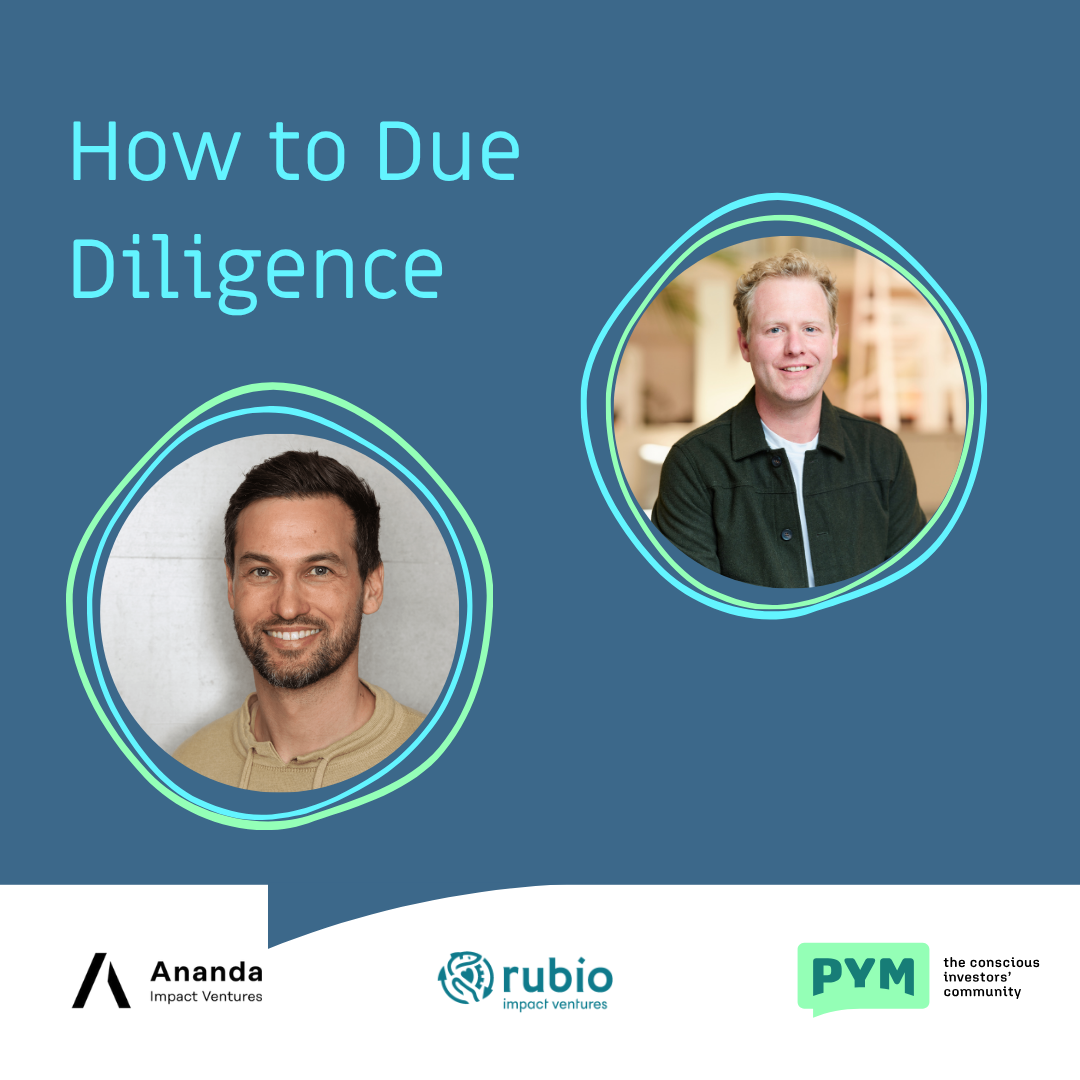
During this interactive knowledge session led by speakers Tijl Hoefnagels (Rubio Impact Ventures) & Johannes Weber (Ananda Impact Ventures), participants explored how to conduct better due diligence on impact funds, impact-driven companies, and investment opportunities. The central message of the afternoon was that good due diligence is not about working through a checklist, but about asking questions that provide insight into behavior, decision-making, governance, and the people behind an organization.
As Johannes aptly summarized: “Life is too short to ask lame questions.” Through a series of examples, participants examined how seemingly logical questions often reveal very little, and how they can be transformed into questions that generate genuine insight.
Due Diligence Questions by Johannes Weber
DD Question 1: “How do you define impact?”
Why is this a weak question?
Almost every impact fund or impact company now has a well-prepared answer to this question. The response often reveals little about how impact is actually applied in investment decisions.
Stronger question
How does your definition of impact influence which investments you do and do not make?
Discussion & Insights
The group concluded that the most interesting information often lies not in the definition itself, but in the personal motivations behind investment decisions.
Questions that can provide deeper insight include:
- Why do you do this work?
- What personally motivates you?
- How do you define success?
- Can you share examples where your impact vision led to a different investment decision?
The discussion also highlighted the importance of genuine curiosity. Good due diligence often seeks to uncover the story behind the strategy.
One participant raised an interesting tension: Is a high IRR ultimately often harmful to people and the planet? This sparked a conversation about the relationship between financial returns and impact, and the importance of maintaining an equal partnership between investors and entrepreneurs.
A key observation was: Entrepreneurs are often rarer than investors. Due diligence should therefore not become a power dynamic, but a process of mutual exploration.
DD Question 2: “How passionate is your team about impact?”
Why is this a weak question?
Almost everyone will say that impact matters to them. As a result, the question generates little meaningful differentiation.
Stronger question
Who within the team is accountable for impact outcomes, and how is that accountability embedded in decision-making?
Discussion & Insights
The group explored how to determine whether impact is truly integrated into an organization or primarily remains an ambition on paper.
Follow-up questions discussed included:
- What happens if impact targets are not achieved?
- Under what circumstances would you sacrifice impact for returns?
- What theory of change underpins your approach?
- Can you share an example of a difficult decision related to impact?
An important insight was that intentionality is often more important than labels such as “impact-first” or “finance-first.”
Ultimately, the key question is: How visible is impact in the decisions being made?
A recurring observation was that accountability within leadership is often a stronger indicator than impact claims in marketing materials.
DD Question 3: “Which impact KPIs do you use?”
Why is this a weak question?
A list of KPIs reveals little about how an organization actually operates.
Stronger question:
How do these KPIs influence investment decisions, portfolio management, or exit decisions?
Discussion & Insights
The group discussed how KPIs can sometimes create a false sense of control, while the most valuable insights often exist beyond the dashboards.
Important questions include:
- Are the KPIs truly material?
- How often are they adjusted to changing circumstances?
- Which negative externalities are considered?
- How are trade-offs between different forms of impact addressed?
One participant asked: How do you make development intentional? This led to a discussion about learning, reflection, and adaptation. An important conclusion was that impact measurement is most valuable when it leads to behavioral change, better decision-making, and continuous improvement.
DD Question 4: “Are you impact-first or returns-first?”
Why is this a weak question?
This question creates an artificial distinction. In reality, investment decisions are usually far more complex than a simple choice between impact and financial return.
Stronger question
Can you share an example of an investment you decided not to pursue because the impact case was insufficient, despite attractive financial prospects?
Discussion & Insights
The group concluded that dilemmas are often far more revealing than principles.
Good due diligence explores:
- Where does friction arise?
- What difficult choices have been made?
- Which compromises were consciously avoided?
- What happens when impact and financial return come into conflict?
Concrete examples often reveal far more than abstract answers.
Johannes Weber’s Favorite Due Diligence Question
Johannes concluded with his favorite due diligence question: Where do you hope the fund or organization will be in five years, and what does success look like in both impact and financial terms?
When different team members answer this question independently, their responses can reveal a great deal about internal alignment. If you receive significantly different answers, this is often a red flag.
Differences may indicate diverging priorities, underlying tensions, or conflicting interpretations of success.
Role Play: LP versus GP
During the second part of the session, participants practiced conversations between LPs (Limited Partners) and GPs (General Partners), guided by Tijl Hoefnagels of Rubio Impact Ventures.
Several important lessons emerged, all connected by a common thread: a conversation should not feel like an interrogation. When people feel interrogated, they tend to shut down.
Good due diligence requires:
- Curiosity
- Active listening
- Building trust
- Creating space for reflection
As one participant observed: "You don't want to become friends, but you also don't want to conduct an interrogation. There is a balance."
Key Conclusion
Good due diligence is not simply about gathering information. It is about having conversations that reveal how people think, make decisions, navigate dilemmas, and take responsibility for both impact and financial performance.