
"A healthier food system needs more than better farming. It needs capital, markets and business models that make change work for farmers."
Anke de Boer
29-9-2026
By Anke de Boer
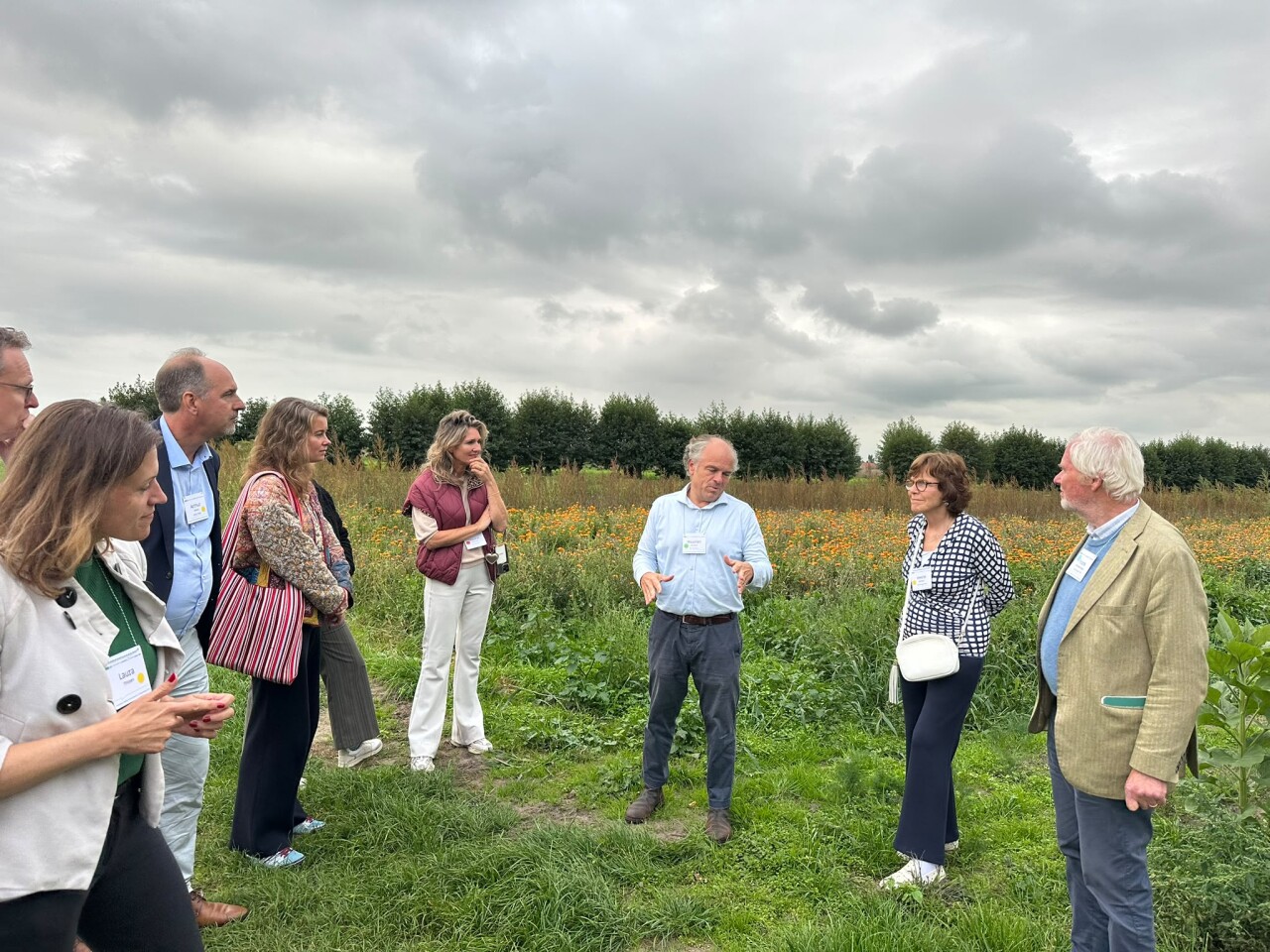
What does it take to build a food system that is healthier for people, planet and farmers - and where can investors make a difference? On 22 September, the PYM community came together at Schevichoven, a regenerative farm in the Netherlands, to explore these questions from farm to fork. Together with investors, entrepreneurs and experts, we looked below ground at the health of our soils, zoomed out to landscapes and global supply chains, and explored new technologies, crops and financing models that could make our food system more resilient. The challenges are significant. But if there was one message that ran throughout the afternoon, it was that there are many points in the system where change is possible - and where private capital can help accelerate it.
Look at the system, not just the farm
Béla Jankovich de Jeszenice opened the afternoon by looking at food systems through three different lenses: as an investor, at landscape level and, drawing on his own family estate in Hungary, from the perspective of a farmer.
Modern agriculture has become extraordinarily good at producing calories at scale. But that productivity has come with consequences for soil, biodiversity, water, climate and human health. At the same time, farmers operate within a highly concentrated system, making it difficult to change one part without considering the rest. Béla therefore made the case for a landscape approach: looking at the relationships between nature, agriculture, communities and economic activity within a particular area. Restoring these systems takes time - often decades - which also creates a role for patient, long-term capital.
From there, molecular biologist Roy Montijn took us below ground, showing how soil health connects to plant and human health through the microbiome. His concept of a microbial continuum - from healthy soil, to healthy plants and ultimately the human gut — added another perspective to the case for regenerative agriculture. Healthy soil is not only about carbon or biodiversity. It is the biological infrastructure on which our food system depends.
The transition has to work for farmers
But understanding what needs to change is only one part of the puzzle. The transition also needs to make economic sense for farmers. Speaking from his experience as both a farmer at Schevichoven and an impact investor through Pymwymic, Maarten van Dam reflected on how difficult that transition can be in practice. Regenerative agriculture can require new knowledge, technologies and ways of working, while benefits such as improved soil health may take years to materialise.
Farmers meanwhile have businesses to run. This tension came back throughout the afternoon. As Alex Rowlett of Sagana explained, farmers can be squeezed between input providers on one side and processors, traders and retailers on the other. Asking them to take on the financial risk of changing how they farm is therefore often unrealistic.
Sagana shared examples of investors and companies tackling three important barriers: access to land, access to capital and access to markets. Models ranged from helping farmers build ownership in the land they work, to using carbon markets to create earlier financial rewards for regenerative practices and combining financing with technical support and access to buyers.
The approaches differ, but the principle is the same: if we want farmers to change, we need to create the economic conditions that allow them to do so. As Maarten put it during the afternoon, conversations with farmers often become much more concrete once you start talking about euros.
Transparency can help shift global supply chains
Those economics do not stop at the farm gate. Thomas Vaassen of Meridia took us into the global supply chains behind commodities such as coffee, cocoa and palm oil. These supply chains can involve hundreds of thousands of smallholder farmers, while surprisingly little may be known about exactly where products were grown and under what conditions.
Meridia started by mapping farms and helping farmers establish clearer records around their land. Today, its technology helps companies trace commodities and identify risks such as deforestation or production in protected areas. The underlying idea is simple but powerful: what becomes visible becomes harder to ignore. Better data does not improve a farm by itself. But transparency can create accountability, give farmers better access to formal markets and allow companies and investors to direct incentives towards better practices. It also shows why food-system investing goes far beyond what happens in the field. Data, financing and supply-chain infrastructure can be just as important to the transition as agricultural technology itself.
Resilience may also mean rethinking what we grow
A healthy food system not only needs to reduce its negative impact. It also needs to keep producing food as the climate changes. Pavlos Kalaitzoglou of Astanor shared how the fund approaches this challenge through investments ranging from biological solutions and automation to more resilient supply chains and crops.
Pádraic Flood of Aardaia then brought one of those possibilities to life - quite literally, by passing it around the room. Of the tens of thousands of edible plant species in the world, our food system depends on remarkably few. Aardaia is exploring whether some plants that have largely disappeared from our diets could become crops for the future. One of them is the aardaker, a protein-rich, nitrogen-fixing tuber that was once eaten in parts of Europe. Aardaia is breeding the wild plant into a crop that could eventually be grown at scale. Because it fixes nitrogen, it has the potential to require less fertiliser, while its underground growth may provide resilience under difficult weather conditions.
This summer offered an unexpected example. Two similar fields were planted at roughly the same time, but only one could be irrigated during the dry weather. While the plants in the unirrigated field looked smaller above ground, sampling suggested that below ground they continued investing in their tubers - ultimately producing more than the irrigated field. It is still early days. But the story raises an interesting question: rather than only asking how today’s crops can withstand tomorrow’s climate, should we also reconsider what we grow in the first place?
Where can your capital make a difference?
Perhaps the clearest takeaway from the afternoon was that there is no single investment opportunity called ‘the food transition’. Investing in a healthier food system can mean investing in farmland and landscape restoration, backing technologies that help farmers reduce inputs, financing their transition to regenerative practices, improving transparency across supply chains or developing entirely new crops.
And these interventions depend on each other. Better technology has limited value if farmers cannot afford to adopt it. Regenerative practices are harder to scale if markets do not reward them. Traceability does not restore soil, but it can create the transparency needed to reward better production. And rebuilding ecosystems takes time, which means the capital behind them needs patience.
Food systems touch climate, biodiversity, water, health, livelihoods and trade all at once. That complexity can make the transition feel daunting. But understanding the system does not mean every investor has to solve all of it. The question is where your capital, experience, network and investment horizon can be most useful.
At Schevichoven, we saw that transition already taking shape: in the soil beneath our feet, in new models that make change viable for farmers, in increasingly transparent supply chains and in crops being developed for a changing climate. For investors, the opportunity is to find where they want to become part of it!