
“Investors should not only look for unicorns, but also for zebras: resilient businesses that quietly form the backbone of sustainable economic development.”
Thekla Teunis
4-8-2026
By Anke de Boer
On 6 July, PYM joined forces with Oikocredit and Grounded for an afternoon exploring what investing across African markets looks like in practice. Hosted at Oikocredit’s international office in Amersfoort, the session brought together private wealth holders and experienced investors to challenge common assumptions about investing on the continent and share practical lessons from years of experience on the ground.
One theme ran consistently throughout the afternoon: Africa should not be viewed as one investment market. It is a diverse continent with different economies, regulatory environments and entrepreneurial ecosystems. While investing in African markets undoubtedly comes with challenges, the speakers argued that many investors still underestimate the scale of the opportunities because they rely on outdated perceptions of risk rather than firsthand experience.
Start small, build knowledge
The first fireside conversation, moderated by PYM Director Suzanne Rosman, featured private investors Jelle Schuitemaker and Jochem Wieringa, both of whom have built significant experience investing across African markets.
For Jelle, the journey started through his medical technology company Goal 3, which develops patient-monitoring technology for hospitals in Rwanda, Tanzania and Malawi. Living in Rwanda not only helped him build a business but also gave him a much deeper understanding of the local entrepreneurial ecosystem. Alongside his company, he began making angel investments and supporting local entrepreneurs, discovering opportunities that simply would not have been visible from Europe.
Jochem followed a different path. After founding several technology companies and an early European blockchain venture capital fund, he realised that impact had become secondary to financial returns. That prompted him to redesign his investment approach around measurable impact, focusing on climate, healthcare and poverty reduction. Today, around half of his portfolio consists of direct investments in early-stage technology companies across Africa.
Rather than encouraging investors to immediately start making direct investments, both speakers stressed the importance of building expertise first. Their advice was simple: begin with one country, one sector or one asset class that you understand well. Investors without the time or network to evaluate companies themselves can work through experienced fund managers or organisations that already have strong local relationships.
Looking beyond perceived risk
Risk was naturally one of the central topics of discussion. Currency fluctuations, changing regulations and political uncertainty are realities that investors need to consider. At the same time, the panel argued that perceptions of risk are often much greater than the realities experienced by investors who spend time on the ground.
News coverage tends to highlight instability, while receiving far less attention are the rapidly growing entrepreneurial ecosystems, highly educated talent pools and increasingly collaborative investment communities emerging across many African countries. This disconnect can actually create investment opportunities. When investors systematically overestimate risk, promising businesses often remain underfunded despite having strong fundamentals.
One example that illustrated this was Octavia Carbon, a Kenyan company developing direct air capture technology. Kenya’s largely renewable electricity grid, affordable engineering talent and supportive ecosystem make it an attractive place to build climate technology—demonstrating that some companies succeed not despite being based in Africa, but precisely because of it.
Investing in the real economy
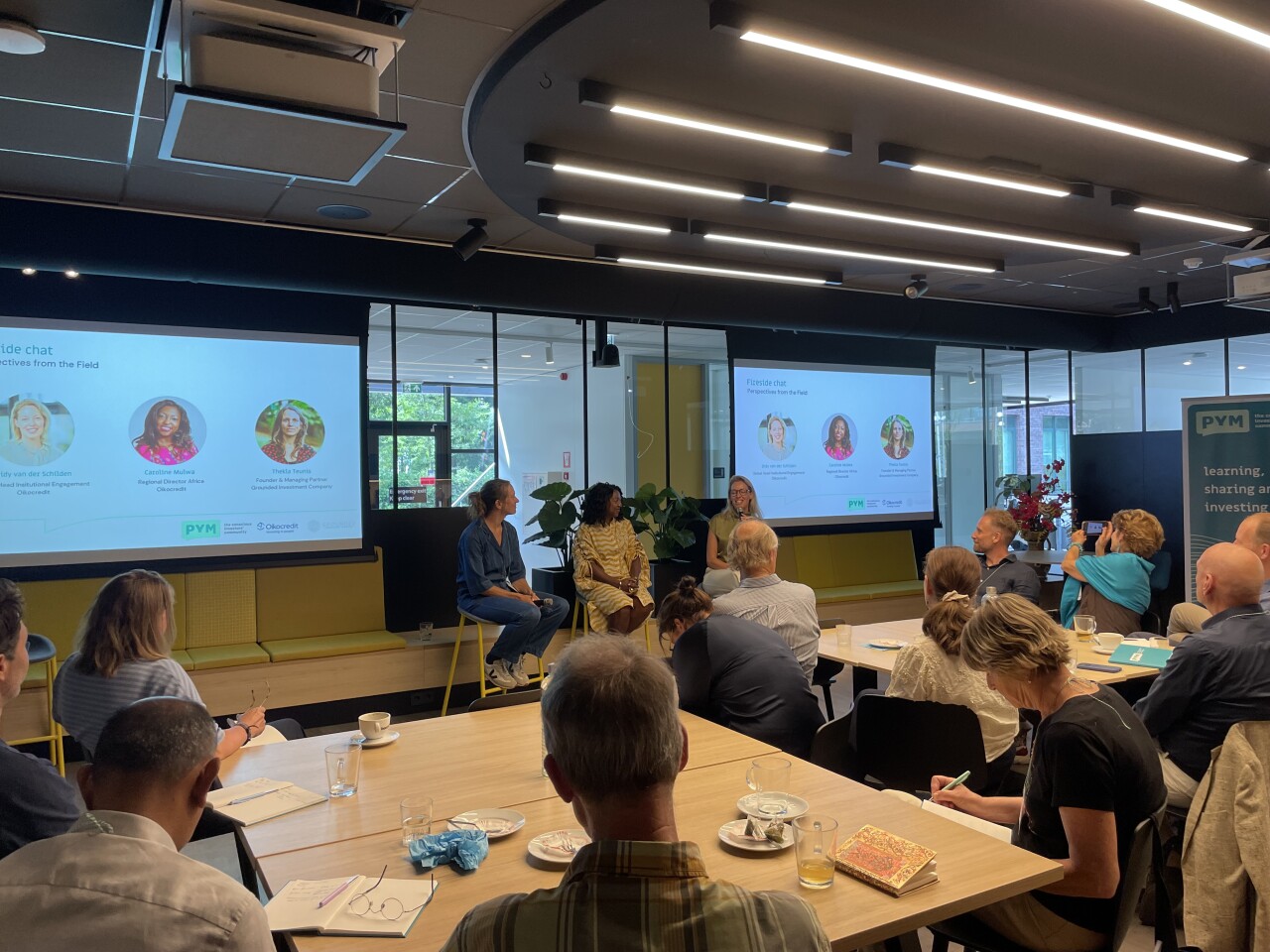
The second panel shifted the conversation from private investors to practitioners working on the ground every day. Moderated by Didy van der Schilden of Oikocredit, the discussion featured Caroline Mulwa, Regional Director Africa at Oikocredit, and Thekla Teunis, Founder and Managing Partner of Grounded.
Drawing on almost two decades of experience, Caroline described a continent characterised by both enormous challenges and enormous opportunity. Africa’s young and rapidly growing population creates increasing demand for employment, healthcare, housing, education and financial services. While these are often framed as development challenges, they also represent significant investment opportunities. Across the continent, entrepreneurs are building businesses that respond to these needs, while development finance institutions, impact investors and private capital all have an important role to play in helping these businesses scale.
For Oikocredit, this translates into a long-term investment strategy focused on financial inclusion, sustainable agriculture and climate resilience. Caroline explained how access to finance—whether through tailored financial products for women entrepreneurs or working capital for agricultural businesses—can strengthen local businesses while improving the livelihoods of thousands of smallholder farmers and their communities.
Thekla offered a complementary perspective through Grounded’s work in regenerative agriculture. She explained that many smallholder farmers are effectively “organic by default”: not because they intentionally farm organically, but because they cannot afford chemical fertilisers or pesticides. The challenge is therefore not reducing chemical inputs, but rebuilding soil health and increasing productivity. Through regenerative practices such as composting, mulching and improving soil biology, Grounded has seen farmers significantly increase yields, improve crop quality and become more resilient to drought.
Grounded also invests in agricultural processing businesses—an often overlooked but essential part of the food system. These businesses create employment, provide stable markets for farmers and strengthen local value chains. As Thekla observed, investors should not only look for “unicorns”, but also for “zebras”: resilient businesses that quietly form the backbone of sustainable economic development.
Investing with an open mind
Perhaps the most important takeaway was that investing in Africa requires moving beyond assumptions. While risks certainly exist, so do extraordinary entrepreneurial talent, innovative business models and investment opportunities that are often overlooked. For investors willing to engage with the continent thoughtfully and patiently, Africa offers the opportunity not only to diversify a portfolio, but also to contribute to solutions addressing healthcare, food security, financial inclusion and climate resilience.
For PYM, the afternoon reinforced exactly why these conversations matter: bringing together investors, practitioners and entrepreneurs to replace assumptions with firsthand experience and build a deeper understanding of how private capital can contribute to meaningful impact.