
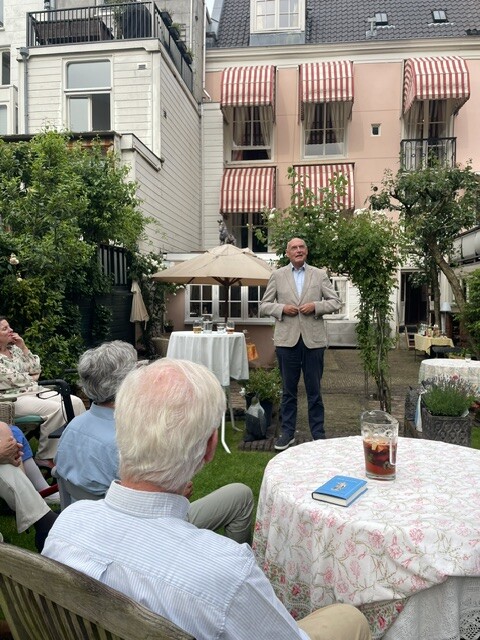
"Sometimes there are meetings that don't necessarily offer new insights, but rather put into words what you have long suspected deep down inside."
3-7-2026
We live in an era where many feel that the old ways no longer work, while the new is barely visible. That can bring uncertainty. We see systems creaking and groaning. We see resistance to change. We see a world that sometimes seems to long for yesterday. But perhaps, as Wijffels suggested, we are looking at these times from the wrong perspective.
Sometimes there are gatherings that don't so much bring new insights, but rather give words to something you have long suspected deep down inside.
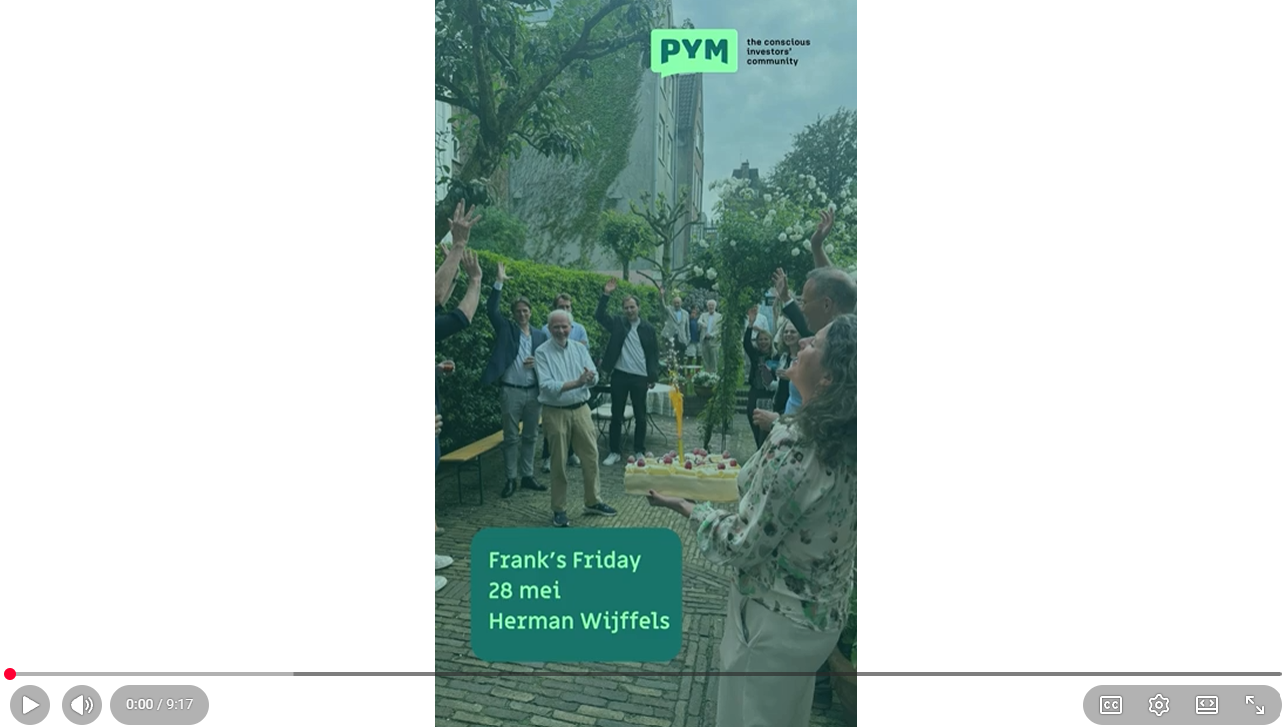
During the last Frank's Friday before the summer, and on the eve of Frank's 80th birthday, Herman Wijffels spoke about the major movements of our time. Not from the perspective of the daily news, but from a deeper layer. The layer beneath the headlines. Beneath the political unrest. Beneath the societal polarization.
His central question was as simple as it was fundamental: Where are we actually headed?
We live in a time where many people experience that the old no longer works, while the new is barely visible yet. That can create uncertainty. We see systems creaking and groaning. We see resistance to change. We see a world that sometimes seems to long for yesterday. But perhaps, Wijffels suggested, we are looking at this time from the wrong perspective.
Perhaps we are not witnessing decay. Perhaps we are right in the middle of a transition to a new narrative.
The End of a Narrative
The past two hundred years were driven by a powerful idea: progress through growth. More production. More consumption. More efficiency. More control. That narrative has brought us unprecedented prosperity. But it has also come at a price.
At the beginning of industrial and scientific development, we realized we could not understand the whole. So we decided to divide reality into smaller and smaller pieces. We started studying parts instead of the whole. Science developed according to the principle of specialization: knowing more and more about less and less.
Subsequently, we also organized our economy, institutions, and society according to that same logic. After about a century and a half, we now live in a society that has increasingly come to consist of broken connections:
-
Between humans and nature
-
Between economy and meaning
-
Between head and heart
-
Between organizations and their social purpose
-
Between each other and ourselves
Not because this development was wrong, but because every successful model eventually reaches its limits.
The Desert Phase
One of the most beautiful images Wijffels used came from the Exodus story. Not as religious history, but as a metaphor for the times we live in.
The here and now forces us to think about the future. And that is precisely what allows people to endure a long transition. People endure difficult periods when they are repeatedly reminded of a vision—an image of how things could be different.
A society does not live on solutions alone, but also on perspective. On the belief that a different way of living together is possible. This is perhaps the desert phase we find ourselves in. We feel that a life based on endless growth has reached its limits. We know things must change. But we don't yet know exactly how.
And precisely then, the temptation arises to long for what we know, even if it no longer truly serves us.
The Real Crisis of Our Time
What struck me most was that Wijffels does not describe the current situation as an energy crisis, climate crisis, economic crisis, or political crisis. According to him, a deeper question lies beneath. A question of consciousness.
As I listened to his story, another question occurred to me. Couldn't you also describe the underlying crisis of our time as a crisis of meaning? In other words: "What are we actually doing it for?" Why you do what you do. For whom you want to matter. And how your life is connected to something larger than yourself.
Perhaps that is the greatest challenge of our time. Because people who have an ideal, a meaningful perspective, or a contribution they want to make can tolerate uncertainty better because they know what they are traveling for.
This requires more than just new technology. It requires a different view of humanity. A shift from extraction to regeneration. From competition to collaboration. From control to connectedness. From isolation to the realization that we are part of a larger whole.
A Simple Compass
At the end, one question lingered. Perhaps the simplest and yet the most fundamental:
Is what we do for life, or against life?
Not as a moral judgment, but as a compass. In our work. In our organizations. In the way we consume. In how we treat each other. In the choices we make when no one is watching. The question, then, is not just how we solve problems but also which narrative gives us direction.
This is precisely why the title of the Impact Days 2026 was so striking: Build Tomorrow, Today. The future isn't waiting for us somewhere. It arises from the choices we make today, in the work we do, and in the contribution we make from our own place. As Maud so beautifully put it earlier that afternoon: not somewhere far away, but small and close by.
Other organizations working on a new way of living together and building economic systems:
-
De Groene Afslag School: Trying to help people take their place in the transition to a new economy through school programs.
-
The Green Times: De Impact Formule, a six-part series searching for a concrete blueprint for meaningful work and entrepreneurship. As the traditional definition of success shifts from profit to social impact, more than 40 experts, leaders, and creatives explore how organizations can succeed while also changing the world for the better.
-
Future Design Institute: building the teams, organizations, and society of and for tomorrow.
If we are missing an organization on this list, please let us know via info@pym.nu