
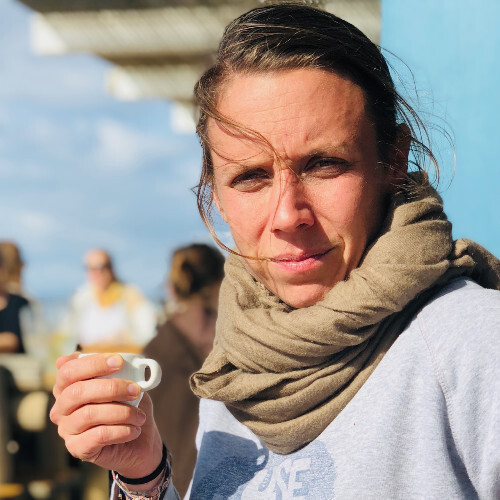
“For many families, money is a mystery, and it becomes this big thing, almost too heavy to touch, sitting there, not helping anybody.”
Marine de Waziers
3-9-2026
Marine de Waziers is a French-Belgian impact investor based in Brussels. She founded ROOM and Wealth Currents Magazine. Together with PYM, she will be co-hosting an evening for French-speaking female wealth holders from Belgium on October 5th.
How did you get into impact investing?
I inherited money after losing my father at the age of 24. It was in a bank account I could withdraw from at any time. However accessible, I didn't touch it for 10 years. In the meantime, I built a wedding dress company with my sister, which introduced me to the complex and problematic supply chain of the textile industry. After a while, I realized I was trying to make changes with my business, whilst my own capital might have been contributing to the very system I opposed. This felt counterintuitive. That is when I started putting my capital to work. My first investment was in a company that I was already using for my own business. It was a natural transition that opened a whole new world for me. Now I invest directly and in funds such as Impact Shakers, Sista fund, TeamPact and Hexa's Energy Resilience Fund.
How does PYM feature in your journey?
PYM gives me a more international view, introduces me to amazing people, and helps me widen my deal flow. It also connects me to the Flemish ecosystem. They bring Francophone and Flemish Belgians together, which is so rare, yet so needed!
What is ROOM?
When I started out, I asked other women how they were managing their capital, and I found out how much of it they were delegating to others. I became increasingly interested in the relationship between women and wealth, especially after meeting Myleen Verstraete (co-founder and board member of PYM) who highlighted the multidimensional impact of female investors. I ended up doing a master's degree in sociology and anthropology to research further. After that, I started ROOM, a community that helps women feel empowered and joyful about our potential to create substantial change.
What interesting findings emerged from your academic research?
I found three golden assumptions that seem to rule people with inherited wealth: the first is that you need to keep accumulating because you need to multiply it by the number of children you have, the second is that you need to optimize for taxes, and the third is that everything needs to go to the next generation. I think these can be challenged, especially because we also need to consider the state of the world we are leaving to them. None of this is worth anything if the world is unjust or unlivable.
How do you see philanthropy in the context of impact investing?
My thoughts around philanthropy have evolved a lot in recent years, mostly by talking to organizations like the Good Ancestor Movement and other radical thinkers. I personally don't believe in investing in companies that I don't think will be successful. As an investor, I fully support all my investments with my network and resources. As a philanthropist, trust is part of the gift. Once I've given the money, I no longer consider it mine. Also, I am interested in tackling the source of the issue rather than providing band-aids, so I currently only give to systems-change philanthropy. A recent example is my support for an artist collective producing a play in Belgium that challenges wealth accumulation. All their work so far has shifted my mindset.
What makes an investment a success in your eyes?
One of my favorite examples is Sojo, a company that does clothing repairs. It's a complicated business in terms of the economics, but the energy of this founder, who is so driven by the mission, inspires me hugely. My husband and I invest separately in principle, but this is one of the few projects we've both invested in. Being able to follow her journey was as important to me as the actual mission of the company. Many companies in the repair space have failed, but she's still going strong. It's been an honor to have been part of her story.
How did your own next-gen experience guide your approach with your own children?
I started to understand that there was money when I was a teenager, but I never thought I'd have to do anything with it myself, because I assumed my father was always going to be around. Losing him in my twenties taught me to be more intentional with my own children earlier on. We have three children: 12, 14, and 16, all with very different worldviews. They don't manage any money themselves yet, but they each have an account in their own name. We're very transparent about what we have, and they have access to a lot of information. I'm not radical in the sense that I believe they have to make it all by themselves. Instead, I am trying to teach them how to manage what we're ready to give them, because that's the reality of their lives. I think for many families, money is a mystery, and it becomes this big thing, almost too heavy to touch, sitting there, not helping anybody. When I was interviewing people for my thesis, so many people said, 'I have a lot.' And I'd think, what is actually 'a lot’? So now the first thing I advise people to do is to make a spreadsheet to arrive at a real number. That's how you begin.
What are you most looking forward to, in the near future?
The first edition of our magazine, Wealth Currents, is coming out! It explores the many dimensions of wealth. We share stories on managing wealth in new ways, feature investments and the expertise behind them, and look at psychological aspects. For example, if you want to invest in something different from what your family has always invested in, how do you broach that with your family? How do you start doing it yourself? How do you separate your investment strategy but still belong to the family?
What's one misconception about investing that you wish more people would let go of?
That you need a certain number of investments before you can call yourself an investor. I call every woman who joins ROOM an ‘investor’ from the start.
Do you want to learn more about impact investing and how other Belgian female wealth holders have set up their portfolios? Join the PYM/ROOM session on October 5th.
If you're not a French-speaking Belgian female wealth holder but still find this topic interesting, you can join us online on September 7th for our Inside Impact Investing webinar.